What Is OSINT? Open-Source Intelligence Explained
OSINT is intelligence built from publicly available information. What counts as open source, the five-stage cycle, the main types, and the legal limits.
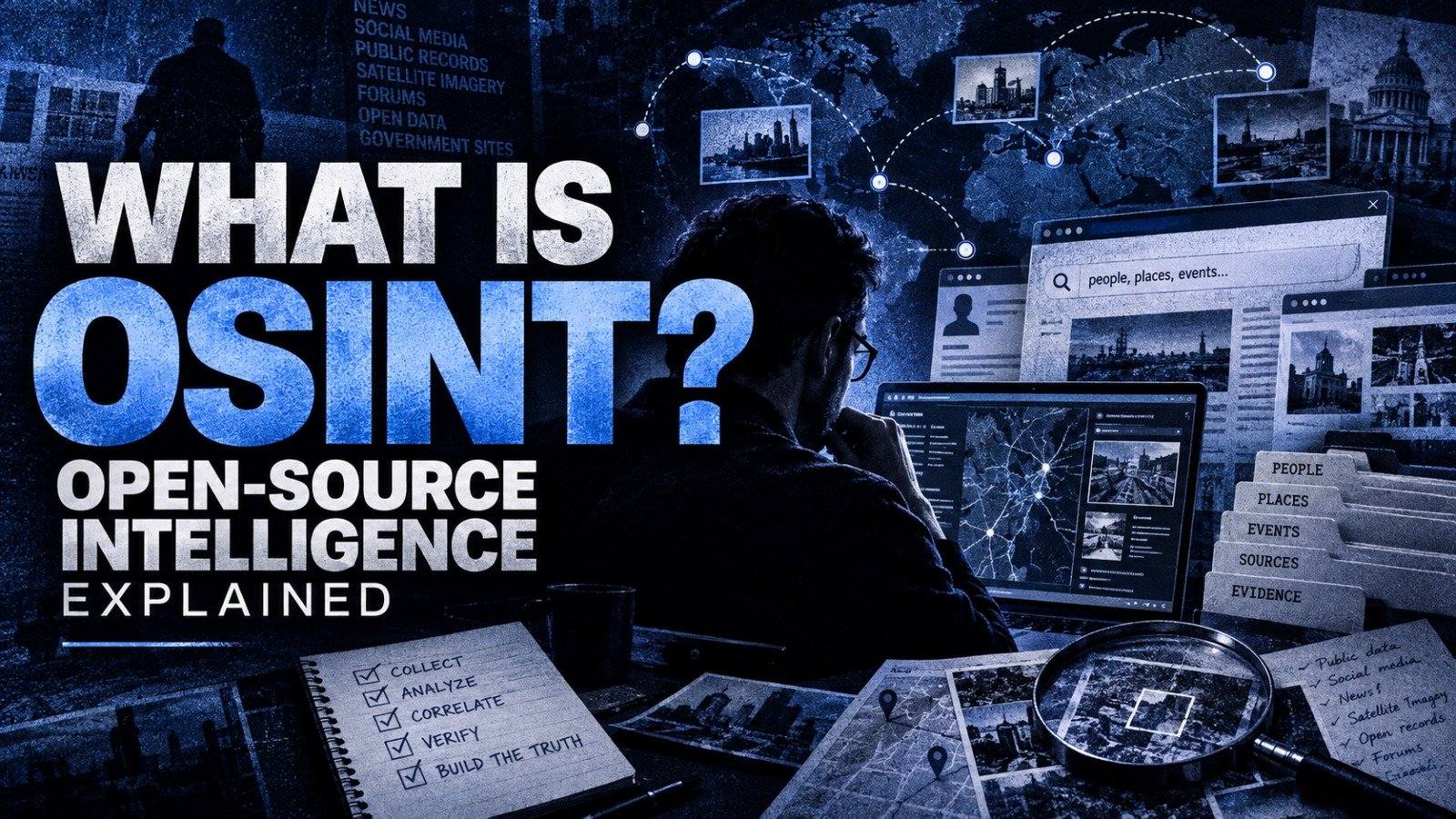
OSINT (open-source intelligence) is the practice of collecting publicly available information and analysing it into something you can act on. "Open source" here has nothing to do with software licensing. It means you obtained the information without hacking, without deception and without privileged access. Anyone with the same skills and patience could have found the same thing.
That last clause is what makes OSINT a discipline rather than a search habit. Anyone can look someone up. An analyst does it in a way that is repeatable, documented, and defensible when someone challenges it, and that difference is what separates an OSINT report from a pile of screenshots.
What does OSINT stand for?
OSINT stands for open-source intelligence. The term comes from the intelligence community, where disciplines are named after the source of the raw material rather than the subject being studied. Open source is one of several such disciplines, and it's the only one civilians, journalists and corporate teams can practise lawfully at scale.
Two words in the phrase are doing real work:
- Open: legally and technically accessible without breaking, bypassing or deceiving anything.
- Intelligence: processed, evaluated and given a confidence level. Raw collected data is information. It becomes intelligence only after analysis.
Practitioners routinely label a list of search results OSINT. That list is collection output, not intelligence. The intelligence appears when an analyst decides what the results mean, what they rule out, and how much confidence they carry.
What counts as an open source?
Open sources cover far more ground than most people assume. The main categories:
- The public web: social profiles, forums, company sites, news archives, plus cached and archived versions of pages that have since changed or been deleted.
- Public registries: corporate filings, domain registration records, court dockets, patents, trademarks, procurement notices, property and vessel registries.
- Technical metadata: data exposed by public endpoints, such as whether an account exists on a platform, when a domain was registered, or what mail configuration a domain publishes.
- Commercially available data: datasets any customer may lawfully purchase, including aggregated marketing and business records.
- Broadcast and print media, including regional and non-English outlets, which are frequently the only place a detail appears.
- Grey literature: conference slides, theses, standards drafts, mailing-list archives, job postings. Search engines index this material poorly, and it frequently carries detail that appears nowhere else.
What doesn't count: anything you obtained by guessing or reusing a password, exploiting a vulnerability, impersonating someone, or scraping behind an authentication wall you weren't entitled to pass. The moment you deceive a system or a person to get data, you have left OSINT and entered something else, usually something illegal.
The test isn't "was it easy to reach?" It's "would the person who published this consider it published?"
OSINT vs. HUMINT, SIGINT and the other disciplines
The intelligence disciplines are named for where the raw material comes from. Knowing the boundaries clarifies what OSINT can and cannot answer:
| DisciplineSource of the raw materialAvailable to civilians? | ||
| OSINT | Publicly available information | Yes |
| HUMINT | People: interviews, sources, elicitation | Partly; journalism and investigations use it |
| SIGINT | Intercepted communications and signals | No. Interception is criminal in most jurisdictions |
| GEOINT | Imagery and geospatial data | Yes, when the imagery is commercial or public |
| MASINT | Sensor measurements and signatures | Effectively no |
| FININT | Financial transaction records | Only the public portion: filings, registries |
In practice the line that matters most is OSINT versus HUMINT. Reading a public post is OSINT. Messaging the person under a false identity to get them to say more is HUMINT, and depending on where you are and who you are, it may be unlawful, unethical, or both. Analysts get into trouble at exactly this boundary, usually by degrees rather than in one step.
What does the OSINT process actually look like?
Practitioners borrow the classic five-stage intelligence cycle:
- Direction: define the question. "Find everything about this person" isn't a question. "Which platforms does this handle appear on, and can any of them be tied to a verified identity?" is. A badly framed question guarantees a useless answer no matter how good the collection is.
- Collection: gather raw material against that question. Tooling automates this stage well.
- Processing: normalise what you collected. Deduplicate, translate, convert every timestamp into one timezone, standardise name and number formats. Skip this and you'll count the same finding three times as "corroboration".
- Analysis: the part nobody can automate. Which findings corroborate each other? Which contradict? What alternative explanation have you not ruled out?
- Dissemination: deliver it in a form the recipient can use and audit, with a confidence level attached to every claim.
Beginners spend nine tenths of their effort on collection. Experienced analysts spend most of theirs on direction and analysis, because collection is where tooling helps and judgement is where it doesn't.
What are the main types of OSINT?
The field splits by what you're investigating rather than by technique:
- Person-centric OSINT: tying identifiers such as a handle, an email address or a phone number to accounts, and accounts to a person. Start with how a username maps to social accounts.
- Email OSINT: the highest-yield pivot in most investigations, because an address is the account-recovery anchor for nearly everything. See what a reverse email lookup reveals.
- Phone OSINT: line type, carrier, messaging presence and account linkage. See what a phone number actually reveals.
- Organisation-centric OSINT: corporate structure, ownership chains, suppliers, staff, exposed infrastructure.
- Infrastructure OSINT: domains, hosting, certificates, mail configuration. Also called technical OSINT.
- Geospatial OSINT: locating and verifying imagery by matching landmarks, shadows, signage and terrain against public map data.
- Social media analysis: network structure, posting patterns, and activity windows that hint at timezone or routine.
Real investigations mix several. A fraud case might start with an email address, pivot through a domain registration to a company filing, and end with an infrastructure finding that ties three "unrelated" merchants to one operator.
What are some real OSINT examples?
Four patterns recur across most investigations:
- The reused handle. A marketplace seller uses a pseudonym. The same string appears on a hobby forum where, eight years earlier, the same person posted under their real name.
- The recovery hint. A password-reset flow displays a masked phone number. A second service masks a different portion of the same number. The two masks intersect to a single candidate.
- The job posting. A company's careers page lists the exact internal systems it runs. That's an infrastructure inventory, published voluntarily.
- The timestamp gap. An account claims to be in one country, but its posting activity has a six-hour hole every day that matches sleep in another.
None of these involve breaking anything. All of them involve noticing what was already visible.
Who uses OSINT, and what for?
The same techniques serve missions that have little in common:
- Security teams map their own organisation's exposed footprint before an attacker does.
- Fraud and trust & safety teams check whether an account belongs to a real, distinct person or to the fortieth persona of the same operator.
- Journalists corroborate documents and verify imagery before publication.
- Due-diligence analysts find out who is behind a counterparty before money moves.
- Law enforcement develops leads that legal process later confirms. OSINT points, legal process proves.
- Recruiters and HR verify claimed credentials and employment history.
- Humanitarian and human-rights researchers document events from public material when physical access is impossible.
Is OSINT legal?
Collecting publicly available information is lawful in most places. That sentence carries more caveats than people notice.
Legality turns on three things that vary by jurisdiction: how you obtained the data, what you do with it afterwards, and whether the subject has protections you must respect. Under data-protection regimes such as the GDPR, "publicly available" doesn't mean "free to process". You still need a lawful basis to collect, store and use personal data, and the subject may retain rights over it. Anti-stalking and harassment laws apply regardless of how you found the information. Computer-misuse statutes apply the moment you exceed authorised access.
The practical rules that keep practitioners out of trouble:
- Only investigate targets you're authorised to investigate. Authorisation is a document, not a feeling.
- Never bypass authentication, rate limits, paywalls or access controls.
- Record where every finding came from and when. An unsourced claim is worthless in a report and indefensible in a dispute.
- Collect what the question requires, not everything you can reach. Over-collection is a liability, not thoroughness.
- Set a retention limit and honour it.
- Store findings with the same care you'd want applied to your own data.
The question is never "could I find this?" It's "am I authorised to look, and can I defend how I looked?"
What are the ethical limits, beyond the legal ones?
Plenty of things are lawful and still wrong. The working distinction most practitioners settle on is purpose. The same query that protects a fraud victim can enable a stalker, and the technique doesn't know the difference. Three habits carry the weight:
- Proportionality. The depth of the investigation should match the seriousness of the question. Verifying a marketplace seller doesn't justify mapping their family.
- Minimisation. If a finding isn't relevant to the question, it doesn't go in the report, even though you found it.
- No contact. Observation is OSINT. Approaching, provoking or deceiving the subject isn't, and that's where most real-world harm starts.
Where does tooling fit?
Tools do the mechanical part: checking one identifier against many platforms at once, normalising the results, and lining up the fields that corroborate or contradict each other. That work matters, because doing it by hand is slow and inconsistent, and inconsistency is how findings get missed.
What tooling cannot do is decide what a result means. Two accounts sharing a username may be one person or two. A breach record dated 2021 may contain data from years earlier, and reading those records correctly is its own skill. A phone number that unlocks an account today may have belonged to someone else last year.
Treat automated output as a set of hypotheses with sources attached. The analyst's job starts there.
What skills does an OSINT analyst actually need?
Less tooling knowledge than newcomers expect, and more of the following:
- Query construction: advanced search operators, and knowing when a search engine is the wrong instrument entirely.
- Source evaluation: telling a primary record apart from a copy of a copy.
- Structured analytic technique: listing alternative hypotheses explicitly instead of defending the first one that fit.
- Record keeping: timestamps, source URLs, captured evidence, and a chain that survives review.
- Language and cultural literacy: naming conventions, transliteration and local platforms are where non-native investigators lose the trail.
- Operational discipline: not contaminating an investigation by logging in from a personal account or leaving footprints on the target's side.
What are the most common OSINT mistakes?
- Confirmation bias. The most expensive error in the field. Once you have a suspect, every ambiguous signal starts looking like proof.
- Treating volume as quality. Two hundred low-confidence hits are worth less than one corroborated finding.
- Ignoring the base rate. A common name matching means close to nothing. A rare one matching is close to conclusive. Establish rarity before you weigh anything.
- Losing provenance. A finding without a source and a timestamp cannot be defended, and a month later you probably can't reproduce it either.
- Contaminating the target. Viewing a profile from an account that notifies the owner ends the covert phase of an investigation permanently.
- Stopping at the first identity. People maintain several. The first one you confirm is rarely the only one.
How do I start learning OSINT?
Pick a target you're unambiguously entitled to investigate: yourself. Run your own primary email address, your oldest username and your phone number. Write down what comes back, where each finding came from, and how confident you are in it.
Two things usually happen. You find accounts you had forgotten, which teaches you why identifier reuse is so productive. And you find at least one confident-looking result that turns out to be someone else entirely, which teaches you the more important lesson: a match is a hypothesis, not a conclusion.
From there, work the three core identifier pivots in order: username, email address, phone number. Practise writing each finding down with a confidence level attached. The habit matters more than the tool.
Frequently asked questions
Is OSINT the same as doxxing?
No. The techniques overlap; the purpose doesn't. OSINT is investigation with authorisation and a defined question. Doxxing is publishing someone's personal information to expose or endanger them, and it's unlawful in many jurisdictions regardless of how the data was gathered.
How much of the internet is actually searchable?
A small fraction. Search engines index a minority of the public web, and much of what matters to an investigation, including registry records, archived pages and platform-internal profiles, isn't reachable by keyword search at all. Assuming a search engine is the whole open source is the single most limiting beginner error.
Do I need to code to do OSINT?
No, but it raises your ceiling. Scripting turns a manual check into a repeatable one, which matters most for the collection stage. The analysis stage stays human either way.
Is a VPN necessary for OSINT?
It depends on the target's ability to see you. For passive collection from public pages, operational separation matters more than network-level anonymity: a dedicated browser profile, and accounts that aren't yours personally.
What is the difference between OSINT and a background check?
A background check is a regulated product drawing on defined record sets, often with legal obligations to the subject. OSINT is a method. In some jurisdictions, using OSINT to make employment, credit or housing decisions pulls you into the same regulatory regime as a background check. Check before you do it.
Orca runs the collection and normalisation steps for usernames, email addresses and phone numbers in one place and timestamps each result, so your time goes into the analysis instead of the gathering.