Reverse Email Lookup: What an Email Address Reveals
An email address is the master key to most online accounts. What a reverse email lookup surfaces, how to run one, and which conclusions to avoid.
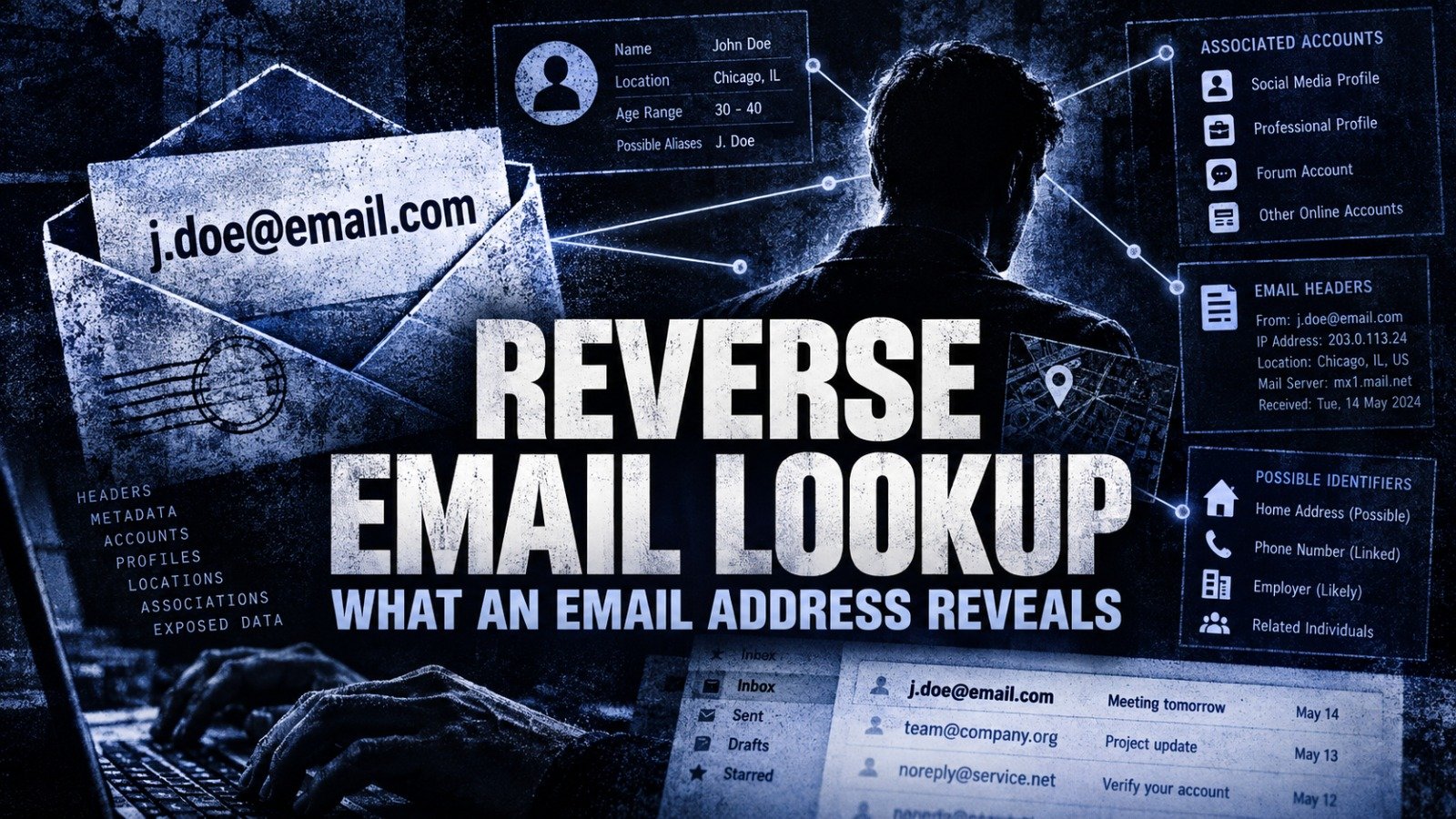
A reverse email lookup starts with an email address and works outward to the accounts, records and identity signals attached to it. In most investigations it's the highest-yield pivot you have, for one structural reason: an email address is the account-recovery anchor for nearly everything a person signs up to.
That also makes it the identifier people ask about defensively: "what can someone actually find with my email address?" This guide answers both versions of the question, in that order.
What is a reverse email lookup?
A reverse email lookup is the process of taking a known email address and identifying what's connected to it. That means which platforms have an account registered to it, which public records or leaked datasets contain it, what the domain says about the sender, and which usernames or profiles derive from it.
The word "reverse" distinguishes it from the ordinary direction. Normally you know a person and want their address. Here you have the address and want the person, or more precisely, you want everything the address touches, from which a person may or may not be identifiable.
Why is an email address such a strong pivot?
Because services treat it as proof of continuity. Password resets, login links, security alerts and account merges all route through it. To function at all, a service has to know which email addresses it already holds, and that knowledge is observable from outside more often than not, because signup and recovery flows have to tell you whether an address is taken.
A username identifies a persona. An email address identifies an account holder. Those are different things, and the second one sits much closer to a person. Someone can abandon a handle in a second. Abandoning an address means losing access to everything registered against it.
People change usernames casually and email addresses reluctantly. That asymmetry is the whole reason this pivot works.
What can a reverse email lookup surface?
Ordered by how much confidence each class of finding deserves, which isn't the same as how interesting it looks:
| FindingWhat it actually tells youConfidence | ||
| Domain facts | Whether the domain accepts mail, and whether it's a disposable-address provider, a free consumer service, a corporate domain or a custom one | High: observable and factual |
| Account existence | Whether the address is registered on a given platform | High, when the check separates a real profile from an error page |
| Breach exposure | The address appears in a publicly circulated dataset | Medium: the claim is only as good as the corpus |
| Masked recovery hints | Partial phone or address fragments shown before authentication | Medium: narrows candidates, proves nothing alone |
| Derived handles | The local part doubles as the person's username elsewhere more often than not | Medium: a lead to test, not a result |
| Linked public profiles | Profiles that publish the address or were registered with it | Medium to high, depending on whether the link is self-declared |
| Self-reported profile data | Display names, avatars, stated locations | Low: people enter whatever they like |
Notice the pattern. The most factual findings are the least exciting, and the most exciting are the least reliable. Investigations go wrong when that ordering gets inverted.
How do I do a reverse email lookup, step by step?
- Normalise the address first. Lowercase it, strip whitespace, and note whether the provider is dot-insensitive or treats
+tagsas part of the mailbox. Two "different" addresses are frequently the same inbox. - Characterise the domain. Free consumer provider, corporate domain, custom personal domain or disposable service? Each implies a different investigation. A custom domain is often the richest, because the registration itself is a record.
- Check whether the mailbox is plausible. Whether the domain accepts mail at all separates a live identifier from a typo or a fabrication.
- Enumerate account existence across a wide platform list. Breadth matters far more here than the depth of any single check.
- Query breach exposure and record the dataset name and date for each hit, not the fact of a hit.
- Extract the local part as a handle and run it as a username. This is where an email pivot feeds a username search, and it frequently doubles the result set.
- Collect masked recovery hints from services that display them before authentication, and write down the constraint each one imposes.
- Corroborate before concluding. Two independent sources for every claim that reaches the report, each with a timestamp and a confidence level.
Steps 1 to 6 are mechanical and belong to tooling. Steps 7 and 8 are where the investigation actually happens.
Can you find someone's real name from an email address?
Sometimes, and rarely from the address alone. Three routes account for most successes:
- The address itself.
firstname.lastname@at a corporate domain is close to a name. At a consumer domain it's a claim, nothing more. - An account that publishes a name. The address links to a profile the person filled in honestly, usually for a service where a real name was useful to them.
- A registry record. A domain, a company filing, or a public listing where the address sits next to a legal name.
What doesn't work is inference by resemblance. jsmith@ is suggestive. It isn't evidence. Addresses get inherited from previous holders, assigned by employers, chosen ironically, and built to mislead on purpose.
What do partial masks actually tell you?
Recovery flows that display a masked hint, such as a phone ending in two digits or an address shown as j••••e@g••••.com, leak more than they appear to. Each mask is a constraint on the underlying value. Collect several masks for the same account from different services and the intersection often narrows to a single candidate.
Treat this carefully. Mask intersection produces a candidate set, not a confirmation, and the arithmetic is easy to get wrong in exactly the direction you were hoping for. Write down the whole candidate set, not the winner, and note how many possibilities each mask eliminated.
How reliable are breach records?
Less than they look. A record from a circulating corpus is a claim made by whoever assembled it, and the fields inside don't all carry the same confidence:
- The keyed identifier is reliable. If the corpus is indexed by email, the email is trustworthy, because that's what made the row findable in the first place.
- Stored fields are medium confidence. Usernames, join dates, credential hashes, IP addresses. The service actually held these, even if the user supplied them.
- Self-reported fields are low confidence. Display names, locations, "about" text, ages.
And the date attached to a corpus is when it circulated, not when the data was created. Corpora get merged, re-shared, re-dated and padded with rows from other sources. Unless you can corroborate independently, write "breach-attributed" rather than "confirmed". The distinction has consequences when someone challenges the report.
What are the false conclusions to avoid?
- Assuming the local part is a name. Plenty of addresses are inherited, assigned or deliberately misleading.
- Assuming one address means one person. Shared household accounts, role addresses such as
info@andadmin@, and forwarding aliases all break the assumption. - Assuming a plus-alias is a different person.
[email protected]and[email protected]deliver to the same inbox on most providers. Confusingly, some services still treat them as distinct accounts, so one person can hold two registrations that look unrelated. - Ignoring dot-insensitivity. On some consumer providers
j.a.n.e@andjane@are one mailbox. On others they're two. Know which you're dealing with before you conclude anything. - Treating a disposable address as a dead end. It's a finding. The person expected the account to be temporary, and that says something about intent.
- Reading absence as proof. No breach hits means the address isn't in the corpora you queried. It doesn't mean the account is clean or the person is careful.
The address tells you which doors exist. Who is standing behind them is a separate question, and it needs separate evidence.
What can I do to reduce my own exposure?
If you arrived here defensively, the practical steps are short and unusually effective:
- Compartmentalise. Use a distinct address for high-value accounts such as banking, primary identity and domain registrations, and never publish it anywhere.
- Use aliases for signups, or a catch-all on your own domain, so a breach at one service doesn't link to everything else you own.
- Move account recovery off SMS where the service allows it. A phone number is its own pivot with its own weaknesses; see what a phone number reveals.
- Audit your recovery flows. Check what each service displays before authentication. If it shows a masked phone number to anyone who types your address, that's a leak you inherited by signing up.
- Break the handle link. If your email local part is also your username everywhere, one pivot reaches all of it.
- Search your own primary address the way an investigator would. What you find is what anyone else would find, and it's the only honest measure of your exposure.
Is a reverse email lookup legal?
Querying public endpoints and publicly circulated datasets is lawful in most places, with the same caveats that govern all of open-source intelligence. "Publicly available" isn't the same as "free to process" under data-protection law, you must not bypass authentication or rate limits, and harassment law applies whatever technique you used.
Two additional constraints bite specifically here. Using the results to make employment, credit, tenancy or insurance decisions may pull you into consumer-reporting regulation in some jurisdictions, with obligations you owe the subject. And sending mail to an address you discovered is a separate act, governed by separate rules from finding it.
Frequently asked questions
Can someone hack me with just my email address?
Not directly. An address on its own grants no access. What it enables is targeting: credential-stuffing against services where you reused a password, phishing tailored to accounts you actually hold, and recovery-flow probing. The address is the map, not the key.
Is it possible to find someone's location from an email address?
Not from the address itself. Locations that surface come from profile data the person entered, which is self-reported and frequently wrong or stale. Mail headers can indicate a sending path, but only if you received a message, and consumer providers strip the originating address from headers precisely to prevent this.
How do I know if my email is in a data breach?
Query the address against exposure datasets and read the dataset names, not the count. A hit tells you which service leaked and roughly when, which is what determines what you should change. A count alone tells you nothing you can act on.
Does deleting an old account remove it from lookups?
It removes the live signal, so the account-existence check stops returning a hit. It doesn't remove archived copies, cached pages or any dataset already circulating. Deletion helps going forward and does nothing backwards.
How accurate are free reverse email lookup sites?
Highly variable, and the failure mode is dangerous. Many return confident-looking profile data assembled by fuzzy matching on a name, without indicating that the match was inferred. If a result doesn't tell you its source and date, you can't use it in anything that will be reviewed.
Orca runs the account-existence, exposure and derived-handle checks for an address together and timestamps each result, so the confidence level behind a conclusion stays visible instead of getting lost between tools.