How to Find Social Media Accounts by Username
A username search can surface accounts across hundreds of platforms. How enumeration works, which variants to try, and how to tell a match from a coincidence.
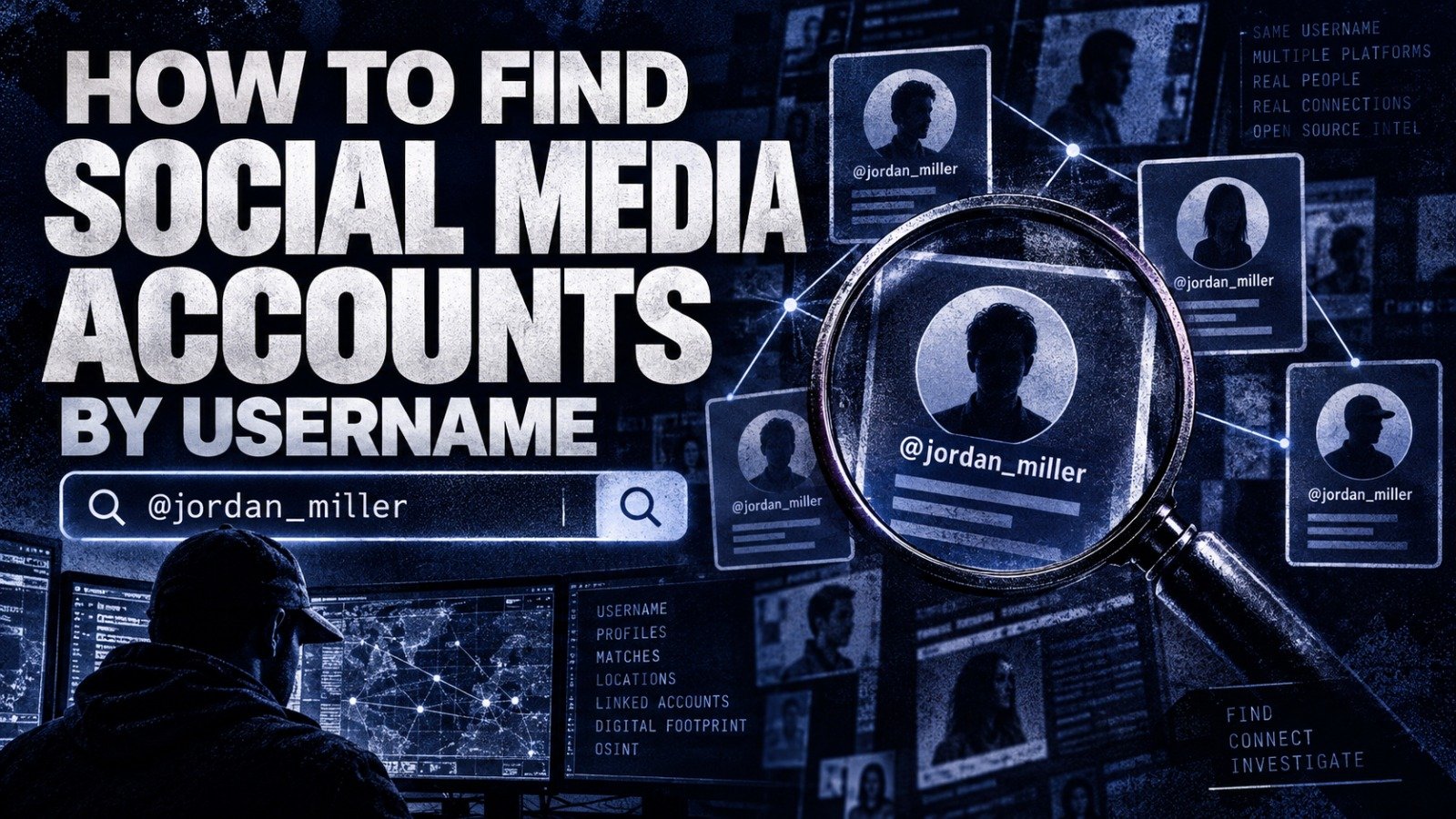
A username search checks a single handle against many platforms at once and reports where an account with that name exists. It's the fastest way to turn one identifier into a picture of someone's online presence, and the easiest place in the whole discipline to draw a confident conclusion that turns out to be wrong.
This guide covers how the technique works, how to widen it with variants, and the part people usually skip: how to verify that the accounts you found belong to the same person.
What is a username search?
A username search, also called username enumeration or a reverse username lookup, tests one handle against a list of platforms to determine where that handle is registered. The output is a list of profile URLs that resolve to real accounts, and that list becomes the starting material for identity correlation.
It answers "where does this name exist". It doesn't answer "who is behind it". Conflating the two is the most common failure in this technique, and the rest of this guide is largely about avoiding it.
Why does a username search work at all?
Because handles are sticky. People choose one early, build reputation under it, and carry it across services for years. Changing it costs recognition: followers, search history, the ability of friends to find you. So even privacy-conscious users keep a stable handle on the accounts they care about and randomise only the ones they consider throwaway.
The gap in that reasoning is what investigators rely on. People are poor judges of which of their accounts are disposable. A forum registration from a decade ago feels irrelevant until it's the record that links a pseudonym to a real name, because the person made it before they had any reason to be careful.
How does username enumeration work technically?
Most platforms expose whether a handle is taken. They have to, or nobody could register. A profile URL returns a page for an existing account and an error for a free one. Enumeration automates that check across a large platform list and records which respond as "exists".
Three things determine result quality:
- Breadth: how many platforms get checked. A handful tells you nothing. Hundreds start to describe a person. Coverage of regional and niche platforms usually matters more than coverage of the obvious ones, because you would have checked the obvious ones anyway.
- Accuracy: whether the check separates a real profile from a soft-404, meaning a page that returns HTTP 200 with "user not found" in the body. Naive checkers produce false positives here constantly, and a false positive is worse than a miss because somebody acts on it.
- Freshness: platforms change their responses. A checker built on last year's assumptions reports wrong answers quietly instead of failing loudly.
How do I search a username across social media, step by step?
- Establish rarity first. Before anything else, work out whether the handle is common. Everything downstream is weighted by this, and doing it last means re-reading all your evidence.
- Run the exact string across the widest platform list you have access to.
- Discard soft-404s. Open a sample of hits and confirm they're real profiles. If a checker returns hits on obviously unregistered handles, treat its whole output as suspect.
- Generate variants: separators, numeric suffixes, truncations, prefixes. Run those too.
- Capture evidence immediately. Profiles get deleted and edited. A screenshot with a visible timestamp is worth more than a URL you can no longer load.
- Score each hit on avatar, bio, cross-link and timing evidence instead of treating them as an undifferentiated list.
- Pivot outward. Any email address or phone number exposed on a confirmed profile opens a stronger pivot than the handle did; see what an email address reveals.
- Write the confidence level down for every account you claim belongs to the subject, and mark clearly which ones remain unconfirmed.
What username variants should I check?
Checking one exact string leaves most of the value on the table. People adapt handles to each platform's character rules and to whatever was already taken. Generate variants systematically rather than by intuition:
Variant typeExamples from janedoeWhy it appears | ||
| Separators | jane.doe, jane_doe, jane-doe | Platforms permit different characters |
| Numeric suffixes | janedoe92, janedoe_92, janedoe1 | The plain form was taken; the number is often a birth year |
| Truncations | janed, jdoe | Older platforms capped handle length |
| Prefixes | realjanedoe, thejanedoe, imjanedoe | Reclaiming an identity after the plain form was taken |
| Transliterations | Multiple romanisations of a non-Latin name | Different services, different spellings, same person |
| Leetspeak | j4nedoe, janed0e | Common in older gaming and forum handles |
A recurring number across several platforms is a strong signal in itself, stronger than the handle, because a person chooses the number once and reuses it without thinking.
How do I tell a real match from a coincidence?
This is the step that separates a lead from a finding. A handle existing on two platforms proves only that the string was available on both. Common handles, meaning first names, ordinary words and short strings, collide constantly.
Corroborate with signals that are expensive to fake:
| SignalWeightWhy | ||
| Explicit cross-link | Very strong | One profile links to the other. The owner declared it. |
| Avatar reuse | Strong | The same image, or a crop of it. People rarely bother changing it. |
| Bio overlap | Moderate | Repeated phrasing, same city, same employer, same linked site. |
| Registration era | Moderate | Accounts created in the same period are more plausibly one person. |
| Activity windows | Moderate | Consistent posting hours suggest one timezone and one routine. |
| Handle alone | Weak | Proves only that the string was free on both platforms. |
Weigh them together, and always against rarity. A single avatar match on a rare handle is close to conclusive. A bio match on a handle like alex proves almost nothing.
Rarity of the handle is a multiplier on every other signal. Establish it first, then weigh what you found.
How rare is the username, and why does it decide everything?
Because it sets the base rate. If a handle is registered on four hundred platforms, that's evidence the string is popular, not that a person is prolific. Ordinary words, first names and short strings are taken everywhere by unrelated people, and a list of hits for one of them is close to meaningless.
A practical calibration: if the handle is a dictionary word, a common given name, or under six characters, treat every hit as unconfirmed until corroborated. If it's an invented compound with an unusual number, one strong corroborating signal is often enough.
What are the common mistakes?
- Treating hit count as significance. Forty hits on a common word means the word is popular.
- Ignoring negative results. The absence of an account on a platform where the person would plausibly be is a finding too. It may mean a different handle, or deliberate separation.
- Collapsing namespaces. Some platforms allow two accounts differing only by a character that looks identical in your font. Compare the raw strings, not the rendered ones.
- Forgetting handle recycling. Some platforms release abandoned handles. The current holder may not be the person whose history you're reading.
- Contaminating the target. Viewing a profile from an account that notifies the owner, or following them by reflex, ends the covert phase permanently.
- Stopping at the handle. Usernames are one pivot. Email addresses and phone numbers reach accounts a handle never will; see what a phone number reveals.
How do I find my own exposed accounts?
Run the technique on yourself. It's the best training exercise available and a genuine privacy audit at the same time. Start with the handle you used when you were fifteen, not the one you use now. Early handles predate any caution, and they're usually the ones that link a pseudonym to a real name.
What to do with what you find:
- Delete accounts you no longer use, accepting that deletion doesn't remove archived copies.
- Change the handle on accounts you keep but want separated. The old URL breaks, which is the point.
- Remove avatars shared across personas. The image links accounts more reliably than the name does.
- Strip cross-links between personas you intend to keep apart. One "my other profile" line undoes everything else.
Is username searching legal?
Checking whether a public profile exists is ordinarily lawful. It's the same request a browser makes when anyone visits a URL. The constraints sit around the technique rather than inside it: you still need a lawful basis to process personal data, you must not bypass authentication or rate limits, and anti-harassment law applies whatever technique you used. The legal boundaries of OSINT covers this in more detail.
The operative rule is unchanged. Investigate only targets you're authorised to investigate, and document how you looked.
Frequently asked questions
Can you find someone's real name from a username?
Only indirectly. The handle leads to accounts. An account may expose a name the person entered themselves, or an email address that leads to a record where a name appears. The username itself carries no identity; it's a pointer, and every step away from it needs its own evidence.
How many platforms should a username search cover?
Enough that absence becomes meaningful. A few dozen mainstream sites tells you little, because those are the ones anyone would check by hand. The value sits in the long tail: regional networks, niche communities and older forums, which is where uncautious early accounts live.
Can someone tell that I searched for their username?
An existence check usually looks like an ordinary page request and leaves nothing visible to the account owner. What does get noticed is what people do next: logging in to view a restricted profile, following, or triggering a "someone viewed you" notification. The search is quiet. The follow-up rarely is.
Why do some results show accounts that don't exist?
Soft-404s. The platform returns a normal success response with an error message in the page body, and a checker that only reads the status code counts it as a hit. Any tool that can't tell these apart will inflate its results, so verify a sample before you trust the list.
What is the difference between a username search and a people search?
A username search tests one string against platform namespaces and returns where it's registered. A people search queries aggregated identity records by name and location. The first is precise and shallow. The second is broad and frequently wrong, because name matching is fuzzy by nature.
Orca runs the enumeration and variant generation across its platform list and puts the corroboration signals side by side, so your time goes into the judgement call, which is the part that actually needs you.