Phone Number OSINT: What a Number Really Reveals
Phone numbers unlock more accounts than any other identifier. What a reverse phone lookup surfaces, how to run one, and why numbers mislead investigators.
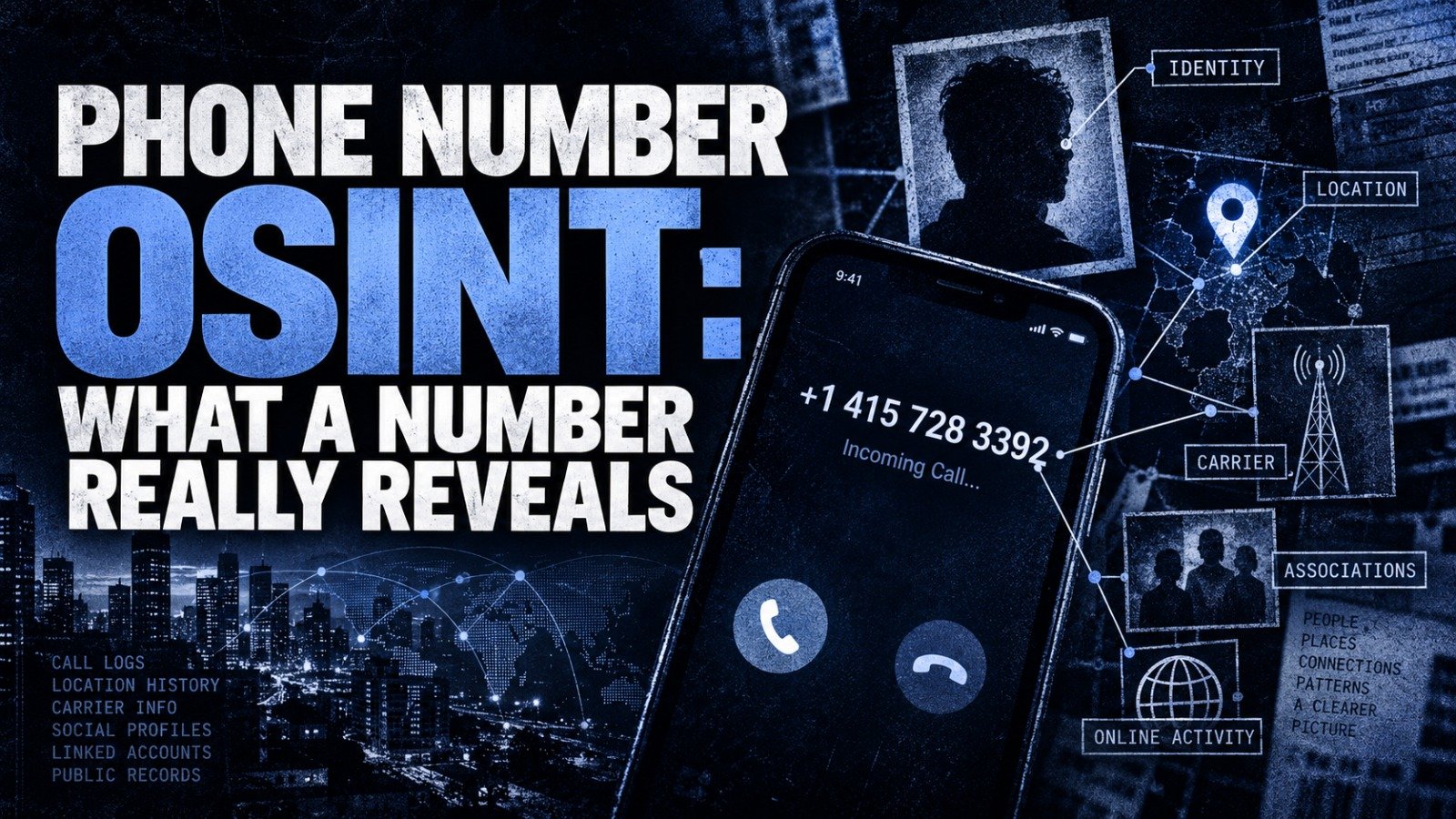
Phone number OSINT is the practice of taking a phone number and establishing what it connects to: the carrier and line type, the platforms where it's registered, the messaging services it's reachable on, and the records that mention it. It's one of the strongest pivots available, and one of the most misleading, for reasons that are structural rather than technical.
Phone numbers sit at a strange intersection. Nearly every online service uses them for account recovery and two-factor authentication, which quietly wires one number into dozens of accounts. That connectivity is why a number is such a productive starting point, and why it misleads people who lean on it too hard.
What does a phone number actually connect to?
Start with what's structurally true and work outward. These findings aren't equally reliable, and treating them as though they were is the main failure mode:
| FindingWhat it tells youConfidence | ||
| Country and area | Where the number was issued, not where the holder is | High for issuance, low for present location |
| Line type | Mobile, VoIP, landline, toll-free. Shapes everything downstream. | High |
| Carrier | The current network. Portability means it may not be the original. | High for current, none for historical |
| Account linkage | Which services have the number registered | Medium to high, depending on the check |
| Messaging presence | Whether the number is reachable on a messaging platform, and any public profile | Medium, and often the richest single signal |
| Public listings | Business directories, classified ads, leaked datasets, CVs | Varies wildly; each needs its own source note |
| Profile photo or name | What a messaging platform displays for the number | Low as identity evidence; see below |
How do I run a reverse phone lookup, step by step?
- Normalise to E.164 first. Convert the number to
+country code and national number, with no spaces, dashes or parentheses. Almost every downstream check expects this format, and half of all "no results" outcomes are formatting failures. - Validate the number is possible. Country codes, national number lengths and prefix ranges are defined. An impossible number is a typo or a fabrication, and knowing that immediately saves an hour.
- Determine line type and carrier. This decides which of the remaining steps are worth running at all.
- Check messaging presence: whether the number is registered on messaging platforms, and what, if anything, is publicly visible.
- Enumerate account linkage across services that reveal whether a number is registered.
- Search the number as a string in its common written formats. People publish numbers in CVs, listings and posts using local formatting, not E.164, so search several forms.
- Pivot to stronger identifiers. A number that surfaces an email address hands you a better pivot; see what a reverse email lookup reveals.
- Date every finding. With phone numbers this isn't bookkeeping. Reassignment makes an undated finding genuinely unusable.
What is line type, and why does it matter so much?
Because it changes what the number means. The same digits imply different things depending on how the line was issued:
| Line typeWhat it impliesInvestigative note | ||
| Mobile | Issued to a subscriber, usually with identity checks | Strongest linkage, and also the target of SIM-swap attacks |
| VoIP | Obtainable in minutes, often anonymously, frequently disposable | The presence of VoIP is itself a finding about intent |
| Landline | Tied to a premises rather than a person | Good for address work, poor for individual attribution |
| Toll-free / service | Organisational, not personal | Pivot to the organisation, not to a person |
A VoIP number attached to a marketplace account isn't neutral information. It says the person chose an identifier that costs nothing to abandon. That doesn't prove bad intent, but it changes the prior.
The recycling problem: why undated findings are worthless
Numbers get reassigned. A mobile line disconnected this year can belong to someone new within months, and regulators in most countries permit exactly that. The consequence is unforgiving: a number that links to an account created in 2019 doesn't prove the current holder opened it.
Two habits fix this:
- Anchor every number-based finding to a date, meaning when the linkage was created, not when you found it.
- Check whether the linkage predates a plausible reassignment window. If it does, say so explicitly in the report instead of leaving the reader to assume continuity.
This is also why recycled numbers cause real harm outside investigations. The new holder inherits password-reset access to the previous holder's accounts, entirely by accident.
Presence is not identity
A messaging platform showing a profile photo for a number is a strong lead, not a confirmed owner. Photos get borrowed, stolen, or set to a pet, a logo or a stock image. Profiles get shared between family members and colleagues. Numbers get handed down within households and reused by small businesses.
Corroborate with an independent identifier before you name anyone. In practice that means a second pivot, such as an email address, a handle or a registry record, that reaches the same person by a different route.
A number tells you which doors exist. Which room you are standing in is a separate question.
What can someone find with my phone number?
If you arrived here defensively, the answer sits between two extremes: more than most people expect, and considerably less than the alarming versions of this topic suggest.
Realistically obtainable: the country and issuing region, the line type and current carrier, whether the number is registered on major messaging platforms, whatever profile photo or display name you've made publicly visible there, whether the number appears in circulating datasets, and any place you published it yourself, such as a CV, a classified listing or a business page.
Not obtainable from the number alone: your live location, your call and message history, your home address, or the contents of anything. Those require either a legal process served on a carrier or a criminal act. Services advertising them to the public are selling aggregated stale records, or nothing at all.
How do I reduce my exposure?
- Set a port-out PIN or account lock with your carrier. This is the highest-value step, because it blocks the SIM-swap path that turns a phone number into account takeover.
- Move two-factor authentication off SMS to an authenticator app or a hardware key wherever the service allows it. SMS is the weakest common second factor precisely because the number is transferable.
- Use a secondary number for signups such as deliveries, marketplaces and loyalty schemes, and keep your primary number for identity and recovery only.
- Restrict messaging-platform visibility. Profile photo, display name and "last seen" are usually visible to anyone who has your number, and usually adjustable in settings.
- Check what you've published. An old CV or classified ad indexed years ago is the most common way a private number becomes public.
- Don't recycle your number as a username. If your handle is your number, one pivot reaches everything; see how a username maps to accounts.
Is a reverse phone lookup legal?
Querying public directories, public endpoints and lawfully available datasets is permitted in most places, under the same conditions that apply to all open-source intelligence: a lawful basis for processing personal data, no bypassing of authentication or rate limits, and no use that crosses into harassment.
Two boundaries deserve naming, because people cross them without noticing. Calling or messaging the number isn't lookup. It's contact, governed by separate telecoms and anti-harassment rules, and it also tells the subject you're looking. And subscriber data held by carriers isn't open source: obtaining it requires legal process, and pretexting a carrier to release it is a criminal offence in most jurisdictions, however routine it looks in television dramas.
Frequently asked questions
Can you find someone's name from a phone number?
Sometimes, and rarely from the number by itself. Names surface when the holder has published the number alongside their name, in a business listing, a CV or a classified ad, or when a messaging profile displays a name they set. Both are self-reported and neither proves who holds the number now.
Can a phone number be traced to a location?
Only to the region where it was issued, which is often not where the holder lives. Number portability and mobile roaming break the link entirely. Live location requires network-side data that only a carrier holds and only releases under legal process.
What is a SIM swap, and why does it matter here?
A SIM swap is an attacker convincing a carrier to move your number to a SIM they control. Because so many services treat the number as proof of identity, the attacker inherits password resets and SMS two-factor codes across every account tied to it. A carrier port-out PIN is the standard defence.
Are free reverse phone lookup sites accurate?
Line type and carrier are usually reliable, because they come from routing data. Names, addresses and "associated persons" are usually stale aggregated records with no indication of age, and they're wrong often enough that you can't use them in anything reviewed.
Is a VoIP number a red flag?
Not on its own. VoIP is ordinary for businesses, travellers and privacy-conscious people. It becomes meaningful in context: a VoIP number on an account that claims a decade of history is a contradiction worth resolving.
Orca normalises a number, resolves line type and carrier, and runs the linkage and presence checks together with a timestamp on each result, so you can answer the reassignment question instead of assuming it.